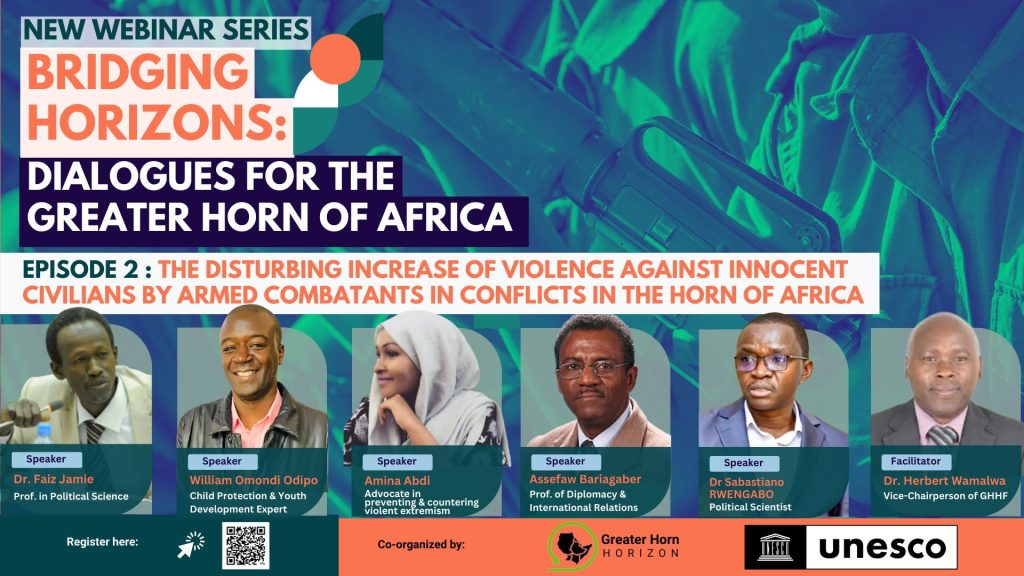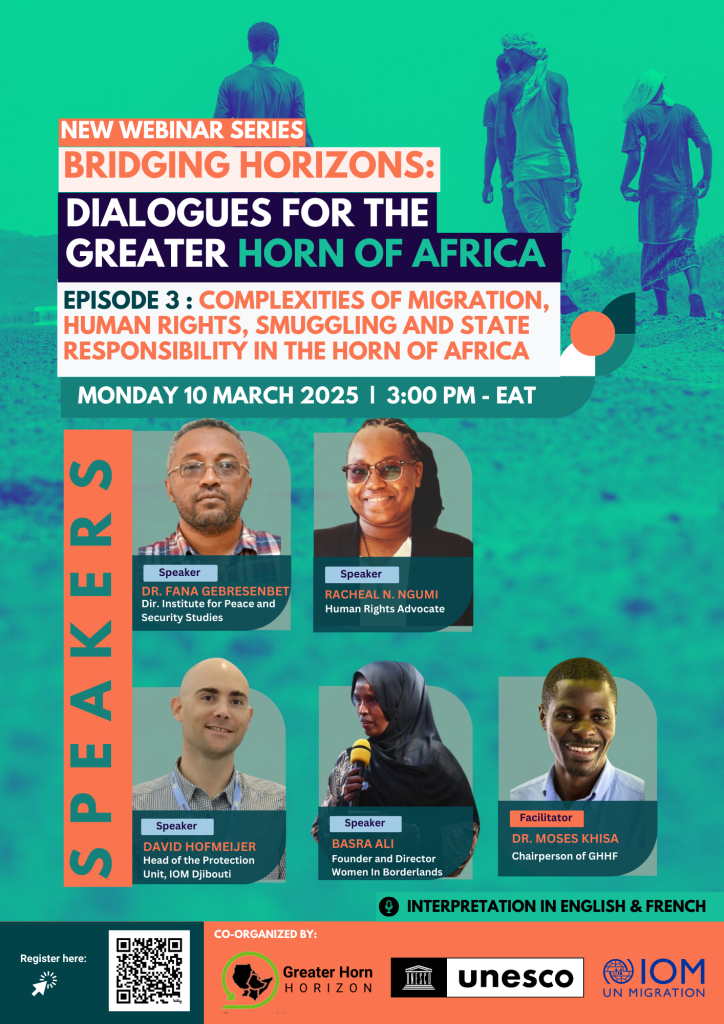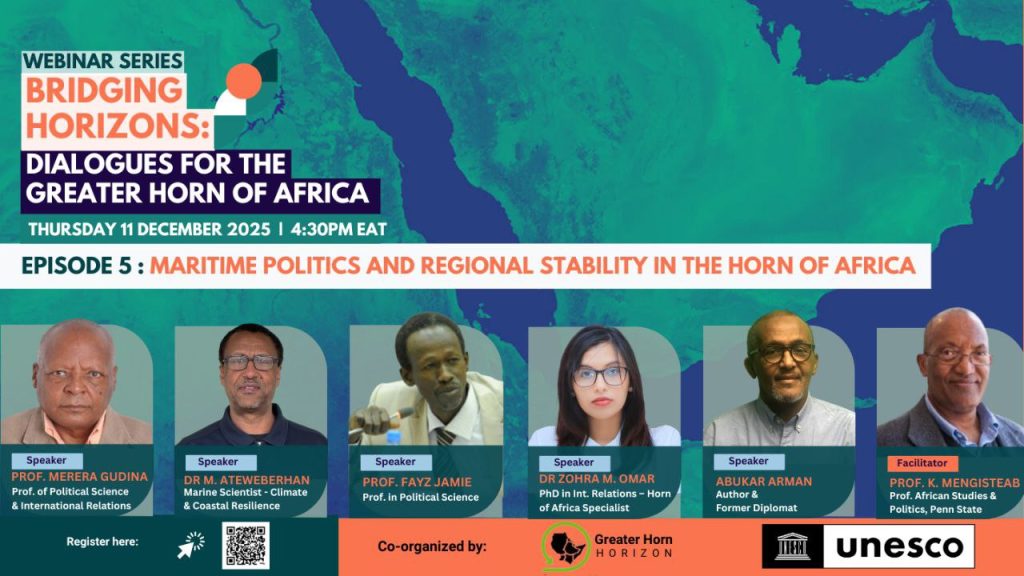
In November 2007, UNESCO — together with a group of intellectuals from the Greater Horn of Africa and its diaspora — launched the Greater Horn Horizon Forum in Djibouti to address the region’s most urgent challenges. Bridging Horizons continues that partnership: a series of interactive webinars convened by the GHHF and UNESCO to provide insight and analysis for peace, security and sustainable development across the region.
The collaboration
The GHHF is an independent forum for policy research and dialogue, working to build consensus on a new vision for the region and to produce studies that inform regional-integration policies focused on peace and sustainable development. It enjoys the support of the African Union and IGAD, and its work encourages exchanges that go beyond analyses of the past and present to explore future scenarios for integration and lasting peace through multidisciplinary research.
Background
The Greater Horn of Africa — Djibouti, Eritrea, Ethiopia, Kenya, Somalia, Sudan, South Sudan and Uganda — faces prolonged conflicts, forced migration, inter-community tensions, rising extremism, widening inequality, and economic and environmental vulnerabilities deepened by climate change. Yet the region also holds significant assets: a strategic location, natural resources, a youthful population, rich cultural diversity and traditional knowledge, and considerable tourism potential. The webinars provide a platform for dialogue and the sharing of expertise among governments, international organisations, researchers and civil society — to better understand the region’s dynamics and support effective, evidence-based policy.
An anticipatory approach
The series uses a future-oriented methodology that explores possible scenarios — not to predict the future, but to give stakeholders a framework for understanding possible developments and making proactive decisions. It proceeds in five steps:
- Contextual analysis — the historical, socio-economic and political context of the region.
- Trend identification — the key trends and drivers of change.
- Scenario building — multiple scenarios from different assumptions about how trends evolve.
- Impact assessment — the implications of each scenario for peace, security and development.
- Strategy formulation — policies that are robust across different scenarios.
Topics under discussion
- Abuses and human-rights violations of international migrants from the Horn — the role of states and of smugglers and traffickers.
- The disturbing rise in violence against civilians by armed combatants in the region’s conflicts.
- Youth unemployment, exclusion from decision-making, migration and radicalisation across the eight nations.
- (Mis)managing political transitions — lessons from recent developments, with a focus on Sudan and its regional implications.
- Maritime politics and regional stability — water resources and access to the sea for landlocked states.
- Enhancing the potential of the Blue Economy among Horn of Africa member states.
Expected outcomes
- Strengthen regional networks of practitioners and experts in peace, security and sustainable development.
- Deepen participants’ knowledge of the region’s challenges and the approaches to address them.
- Develop concrete recommendations for policy and practice.
- Raise awareness of the region’s challenges and opportunities.
- Produce reports, policy briefs and reference documents for lasting impact.
Format
The series comprises six interactive webinars of 60–90 minutes, held via Zoom with simultaneous English–French interpretation. Each session features distinguished speakers — scholars, researchers, activists and practitioners, with deliberate space for young researchers and attention to gender balance — followed by an open dialogue among speakers and participants.
Co-organized by the Greater Horn Horizon Forum and UNESCO.